

Sightings
How to Tell a Raven from a Rook: A Side-by-Side Comparison for Beginners
September 12, 2026
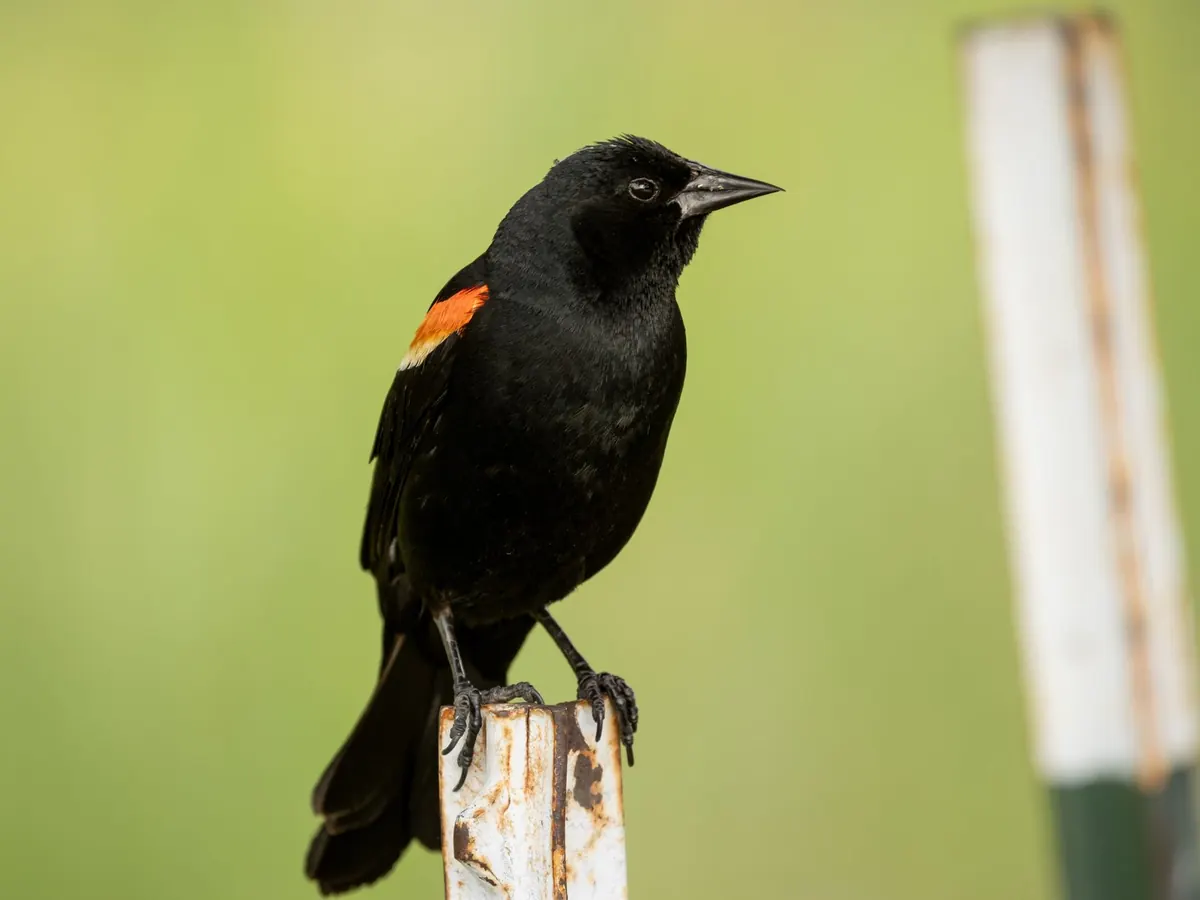
A black bird lands on a fence post, folds its wings, and looks at you with the flat confidence that only a corvid can manage. And there it is — the small nagging question. Rook or raven?
Both are black, both are clever, both are loud enough to wake you at dawn. But they are very different birds once you know what to look at. The trick is not to rely on one feature. Build a case from several at once — bulk, bill, face, silhouette, voice, and where the bird is standing — and get two or three of them to agree before you commit. Here is what to look for.
Size and stance: the first honest impression
Ravens are the largest corvids in Britain, roughly buzzard-sized in bulk, with a heavy body, deep chest and a thick neck. Rooks are considerably smaller — closer in size to a carrion crow, though rangier and more loose-limbed.
Side by side, the difference is obvious. On a lone bird, however, distance plays tricks, so judge the impression rather than the measurement. A raven looks like it has weight. Its throat feathers stick out in shaggy points, its head is big and its shoulders are broad. A rook looks lighter and sleeker, with a slight peak to the crown and feathering that hangs loose around the top of the legs, rather like baggy trousers.
Numbers help too. Rooks are sociable almost to a fault and you will usually meet them in a gang, streaming across a field or bickering in treetops. Ravens are usually seen in pairs, or as a family party of three or four, and they tend to keep their distance from people.
Bill and face: the quickest giveaway
An adult rook has a patch of bare, greyish-white skin at the base of the bill, giving it a chalky, pale-faced look that is visible at a fair range in decent light. The bill itself is narrower and more pointed than a raven's, and the bird's forehead slopes up to a peaked crown.
A raven has no bare face patch at all. Feathers run right up to the base of a heavy, deep bill with a distinctly curved upper edge and stiff bristles covering the nostrils. Seen in profile, a raven has a flatter crown and a heavier brow, giving it something of a Roman-nosed look compared with the rook's neat, sloped forehead.
One warning: young rooks in late summer and autumn still have feathered faces, so they can look misleadingly crow-like. If you are faced with a field full of black corvids with feathered faces, arguing over stubble, they are almost certainly rooks — the group behaviour gives it away before the face does.
Wings and tail: reading the silhouette in flight
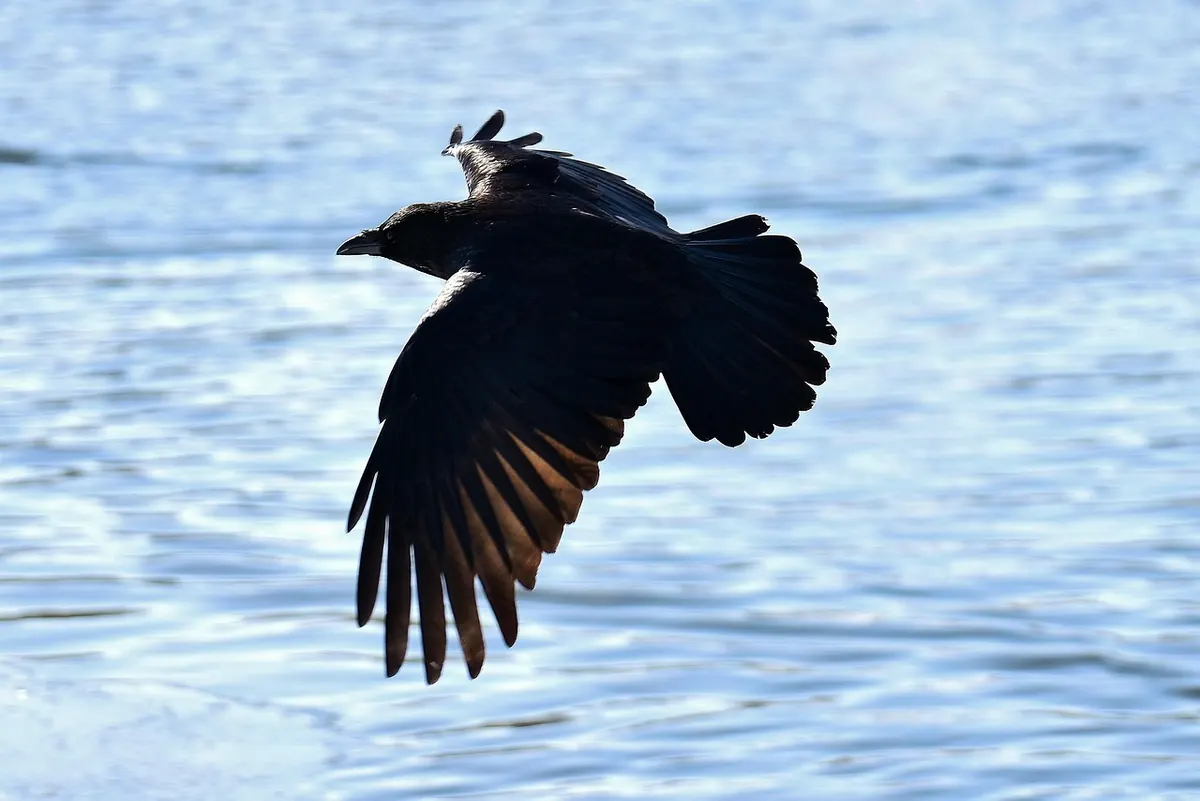
Flight is where ravens become unmistakable. Their wings are broad, and when they glide or soar the wingtips splay into long, separated "fingers". The tail is long and wedge-shaped, or diamond-shaped when spread. Their wingbeats are slow and deep, and they spend a great deal of time gliding, soaring and tumbling in display, especially over a ridge or a cliff edge in spring.
Rooks have narrower wings and a shorter, more rounded tail. Their flight is faster and more workmanlike, a steady flapping progress rather than a glide. You will often see them in straggling lines, heading out to feed in the morning or returning to a communal roost at dusk.
A rough rule of thumb: if it is soaring with fingered wingtips, think raven. If it is a flapping crowd crossing a field in loose formation, think rook.
Voice: the sound test
Raven calls are deep, resonant and hollow — a low, ringing kronk or prruk that carries a long way and sounds as though it came from something bigger than a crow. Pairs call to one another in duet, and in display flight you may hear a strange woody twang or snap from the wings themselves.
Rooks are harsher. Theirs is a flat, grating caw, sharper and more nasal than a raven's call, and around a nesting colony it becomes a rolling wall of noise that you will hear before you see a single bird.
Habitat: where you are standing
Rooks belong to farmland, pasture, playing fields, parkland and the edges of villages. They feed on the ground in groups, probing the soil for invertebrates, and they nest colonially in tall trees — a rookery is one of the loudest and most recognisable features of the British lowlands. Rooks start rebuilding those nests remarkably early in the year.
Ravens traditionally favour crags, moorland, sea cliffs, quarries and wooded hillsides, especially in the west and north, and nest as solitary pairs on ledges or in tall trees. They also nest very early, often while the weather is still grim. In recent decades they have spread into more lowland and even urban areas, so habitat alone is never proof. Use it as supporting evidence, not as the verdict.
A quick field checklist
Run through these in order. The more that point the same way, the safer your identification.
- Group of black corvids feeding on a field: rooks, almost certainly.
- Pair soaring over a ridge with splayed wingtips: ravens.
- Bare greyish-white face patch on an adult bird: rook.
- Fully feathered face, heavy bill, shaggy throat: raven.
- Deep ringing kronk overhead: raven. Grating chorus from treetops: rook.
- Long wedge tail while gliding: raven. Short rounded tail, constant flapping: rook.
Practise on a bird you know
Nobody gets good at this from a page of description. Go and stand near a rookery you can find locally, ideally in late winter when the birds are busy around the nests, and watch them properly for ten minutes. Learn the bill, the sloping forehead, the loose thigh feathers and the flat caw until they are fixed in your mind.
That known bird becomes your yardstick. Once rook is solid, raven stands out immediately — too big, too heavy-billed, too slow-winged, too quiet and too alone. If you are still unsure, spend a little longer on the bird and note down what you saw rather than forcing a name onto it. A second look, or the sound of a single call, will usually settle the matter.
And be careful about what you report. In places where ravens are genuinely scarce, a doubtful sighting of one can cause a lot of unnecessary excitement, while rooks in a lowland field are simply part of the scenery. Identify on the bird, not on the hope.
Photo: Scott Platt / Pexels
Related posts
More stories you’ll love reading