

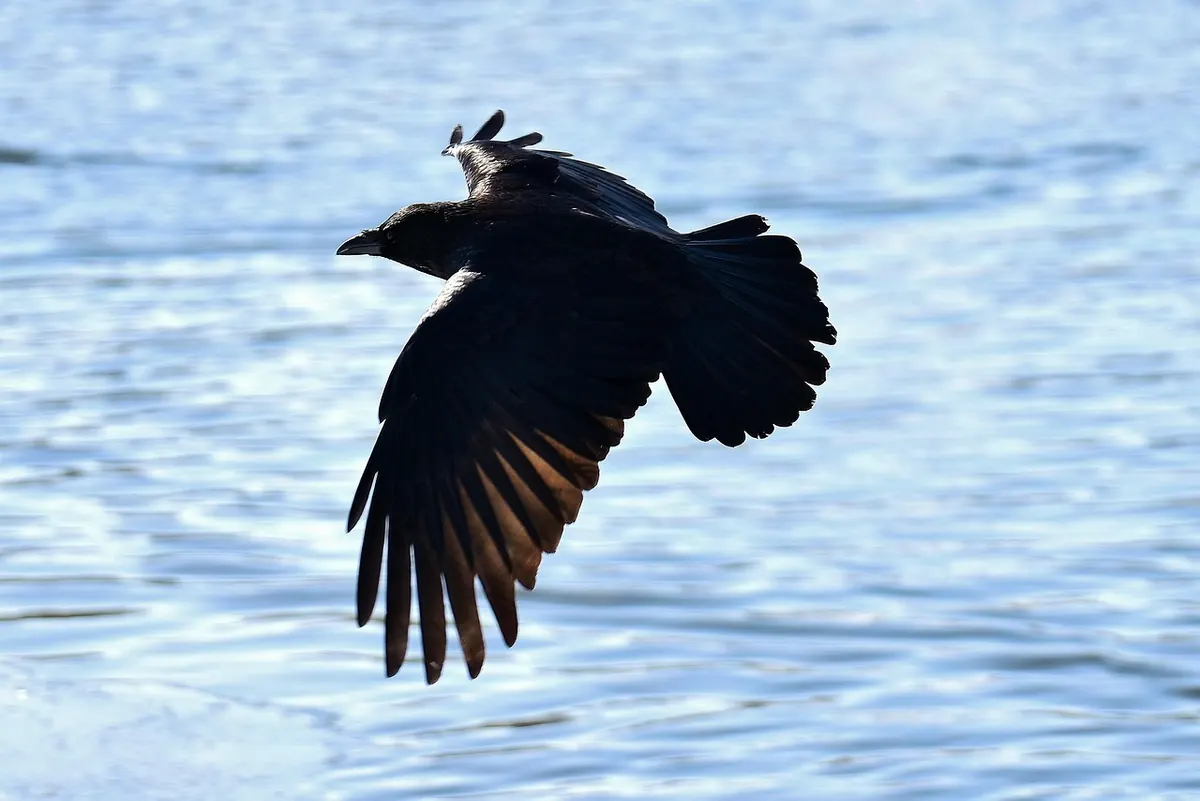

Ravens talk. A pair working a Welsh hillside or a Highland glen can keep up a conversation for ten minutes without repeating a phrase, and their voices are the quickest way to tell a raven from a crow — even when the bird is a speck against grey cloud. Six sounds cover most of what you will hear.
Raven or crow? A ten-second check
A carrion crow's standard call is a flat, hard caa — edged, repetitive and roughly the same every time. A raven's is lower, rounder, and often rolls or wavers in the middle. Ravens also make noises no British crow makes: a ringing single note like a small bell, and a dry wooden knocking that sounds more like a tool than a bird. Size helps in good light — ravens are roughly buzzard-sized, with a wedge-shaped tail and shaggy throat feathers — but sound is often the first clue, particularly when the bird is high overhead and scale means nothing.
1. The deep croak
This is the default raven: the sound most people mean when they say a raven "kronks". Written down it usually appears as kronk, crruck or quork. It sits well below anything a rook or crow can manage, with a hollow, almost wooden centre to the note — a plank struck with a mallet rather than a shout. You will hear it in flight, given slowly, often in twos and threes, with a mate answering from a ridge or a treetop.
If the sound seems to land in your chest rather than your ears, that is the one. Note the pitch as low, the pace as slow, and the spacing as even.
2. The knocking alarm
Dry, staccato and oddly mechanical: a stick dragged along metal railings, or a woodpecker drumming a dead branch. The usual pattern is a run of three to eight notes, often quickening towards the end. Ravens give it when something is bothering them — a walker with a dog, a fox working along a fence line, anything near a nest, a roost or a carcass.
A dry klock-klock-klock, quickening, like a stick dragged along railings — bird perched in a Scots pine, dipping its body with each note.
That is the sort of entry worth making in a notebook. And if you hear the knocking, stop. It usually means you are the disturbance.
3. The bell-like 'toc'
A single, clear, ringing note — a small bell tolling, or a coin dropped onto stone. It is often written as toc or tock, and it is the most useful separator of all, because crows do not ring. Sometimes it comes alone, sometimes in a slow series with a second or more between notes, usually from a perched bird or a pair sitting together in a tree.
Exactly what it means is less well settled than the other calls. That makes it a good one to watch: note what the bird was doing, who else was nearby, and whether the spacing stayed steady.
4. Gargles, rattles and nasal whines
Up close, ravens get strange. The gargle is a wet, bubbling rattle, like a comb run along a table edge or a small engine turning over, often mixed with clicks and given by birds feeding or jostling together. Then there is the nasal quaa — a thin, drawling, complaining sound, halfway between a whine and a sneeze. Juveniles begging from a parent give it constantly in late spring and early summer.
5. Clicks, snaps and borrowed sounds
Ravens snap their bills, click their tongues and pop out short notes that carry only a few metres, so you need to be close. They are also capable mimics and can pick up other birds' calls and odd whistles. Do not expect it on every walk — but if a raven produces something you cannot place, write it down anyway. Half of learning these calls is refusing to dismiss what you have just heard.
Describing a call accurately
Most beginners write "crow-like noise" and learn nothing. Slow down and break the sound into parts:
- Pitch — high or low? Ravens sit at the bottom of the crow range.
- Pace — slow, even, quickening, hurried?
- Rhythm — one note, pairs, runs of three or more, irregular?
- Quality — hollow, wooden, dry, ringing, nasal, wet, metallic?
- Structure — how many notes, and roughly how far apart?
Two comparisons are worth more than ten adjectives, so reach for real sounds: a gate hinge, a dropped coin, a ruler on a desk, a distant chainsaw.
Recording it properly
- Note date, time, place, weather and wind before you switch anything on.
- Write down what the bird is doing: perched or flying, feeding, alone or paired, near a nest.
- Use a windscreen. Wind ruins more recordings than distance does.
- Record long: start before you think the call is coming and keep rolling for thirty seconds after.
- Keep levels low so the loudest note does not distort, then raise it later.
- Stand still and let the bird come to you, where you can do so safely.
- Stay silent. Keep your own voice out of the file.
- Label files the same day — date, place, species, sound type.
- Log the words you used to describe it. Those are your field marks.
Every wild bird in the UK, along with its nest and eggs, is protected by law, and disturbing a nest can be an offence. Keep well back, and check current guidance from the relevant statutory nature conservation body if you are unsure.
Your first week of listening
Pick a spot where ravens are known to pass — a coastal headland, a moorland edge, a big conifer wood at first light. Give it ten minutes, same time each day, and log what you hear in the six categories above. Start by waiting for the deep croak, because it is the one you will get first and the one that confirms the bird. Once you have that, the knocking and the toc fall into place quickly.
Recording a crow and a jackdaw on the same day helps more than you would expect: played back to back, the depth of the raven becomes obvious. Within a week you will have your own words for these sounds — and those words will stick far better than anyone else's.
Related posts
More stories you’ll love reading