

Culture
Ravens in British Folklore and Legend: From the Tower of London to Celtic Myth
September 28, 2026
No British bird carries more baggage than the raven. It is a scavenger that medieval writers linked with battlefields, a resident of one of our most famous fortresses, and a creature whose collective noun — an unkindness — hints at the unease it has long provoked. Britain's ravens are also, at the moment, doing rather well for themselves. Teasing apart the folklore from the natural history makes the stories richer, not poorer.
The Tower of London: a legend with a paper trail
The most famous raven story in Britain is the claim that if the birds ever leave the Tower of London, the kingdom will fall. The version most people know — a royal decree, clipped wings, a careful headcount — is largely a Victorian and twentieth-century confection, polished for tourists and newspapers. But it grew from something real. Ravens are known to have lived around the Tower for centuries, feeding on the scraps, refuse and worse that a busy fortress produced.
What is true today is straightforward: a small group of ravens is kept at the Tower by a dedicated ravenmaster, their flight feathers trimmed so they stay close, and the birds are cared for under the eye of Historic Royal Palaces. The legend is maintained as tradition rather than as prophecy, and it is cheerfully retold every time a bird wanders off — which has happened more than once.
Older than the Tower: ravens in Celtic and Welsh tradition
Long before anyone worried about a kingdom and a fortress, ravens appeared in the older stories of these islands, and often with more complexity than the simple omen they later became.
- Brân the Blessed. In the Mabinogion, the Welsh collection of medieval tales, Brân is a giant king whose name means "raven". After his death his severed head is said to have been buried in London as a protective charm — an echo, some writers suggest, of the Tower ravens.
- The Morrígan. In Irish tradition the Morrígan is associated with the crow and raven, appearing over battlefields. The bird is a witness to slaughter, not its cause.
- Arthur's ravens. A Cornish tradition holds that King Arthur's spirit lives on in a raven, and that harming one brings bad luck. The story is folk belief, not recorded history, but it has proved remarkably durable.
In each case the raven is a messenger between worlds — gifted with speech, memory and patience, which is precisely what the real bird is.
Place names and surnames: where the bird left its mark
The raven is written across the British map. Old English hræfn and the Scandinavian hrafn sit behind names such as Ravenscar on the Yorkshire coast, Ravenglass in Cumbria and Ravensworth in Northumberland. Bran appears in Welsh place names including Cwm Bran, and in the village of Brancaster in Norfolk. Crow-based names — Crowborough, Crawley — usually refer to the crow rather than the raven, and the two are often confused.
Surnames tell a similar story: Raven, Rennie, Ranald and Corbet (from the French for raven) all point to a family that took its name from the bird. A quick look at an Ordnance Survey map or a local place-name dictionary will turn up examples near you within a few minutes.
Heraldry, poetry and the gothic raven
Ravens perch in the corners of several coats of arms, and the bird appears in clan badges in Scotland, where it was long associated with watchfulness and prophecy. In literature, Shakespeare used the raven as a bird of ill omen — "the raven himself is hoarse" in Macbeth — and Desdemona's line in Othello about the raven croaking over the house carries the same charge. Dickens picked up the tradition with the raven Grip in Barnaby Rudge, a bird so memorable that it helped inspire Edgar Allan Poe's poem. The gloomy raven of the Victorian imagination owes as much to these writers as to any genuine superstition.
What the bird is actually like
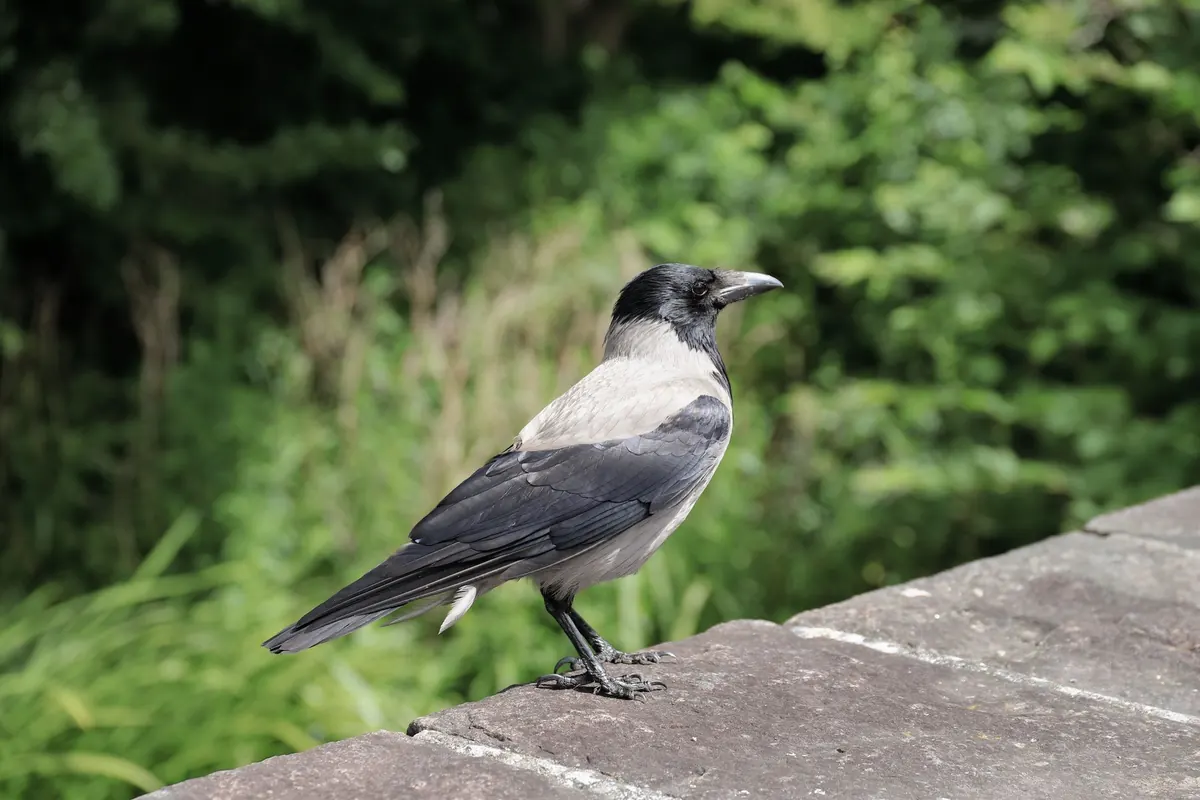
Ravens are the largest members of the crow family, noticeably bigger than carrion crows, with a heavier bill and a distinctive wedge-shaped tail in flight. Their call is a deep, resonant croak, quite unlike the crow's flat caw, and they are famous for tumbling and somersaulting in the air. They mate for life, hold territory year-round, and are capable of mimicry. Persecution pushed them out of much of lowland England, but they have rebounded in Wales, Scotland, the West Country and parts of northern England.
They are also protected. Under UK law it is an offence to take, injure or disturb ravens or their nests, so admire them from a distance and keep dogs and drones away from nest sites.
How to see one, and how to use the folklore
If you want to meet the bird behind the myth, head for upland Wales, the Scottish Highlands and islands, the Cornish and Pembrokeshire coasts, or the Tower of London itself, where the resident birds are easy to watch. Listen first: the deep call and the sound of wings in a stiff breeze usually give them away.
When you retell the legends, it helps to be clear about which is which. The Tower prophecy is tradition rather than royal decree; the link to Brân and the Morrígan is genuine medieval storytelling; the place names are solid linguistic history. Enjoy the stories — and if the bird's protected status ever matters in practice, whether for a conservation project, a land dispute or a planning issue, take advice from the relevant statutory nature conservation body rather than relying on folklore.
Photo: Christina & Peter / Pexels
Related posts
More stories you’ll love reading